As we approach the holiday season, we find ourselves in the midst of a less desirable time of year: cold and flu season. In the roughly six years since the emergence of COVID-19, infectious disease control has become a hot topic. Vaccines and novel treatments can be highly effective in preventing death and suffering from disease, but for us at PW Trenchless, the real hero is infrastructure.
Prior to advancements in microscopy, chemistry, and biology through the 18th and 19th centuries, germ theory was impossible to verify. Left with only cause and effect–that which they could directly observe with their eyes, or wisdom passed down through the generations–humans found alternate ways to describe and understand disease.
By around 3000 BC, Mesopotamian texts describe differences between “sweet” and “bitter” or “foul” waters, demonstrating a basic understanding of the connection between water quality and disease. Clay tablets from the time period describe the process of brewing weak beer in the format of a hymn in honour of the Mesopotamian goddess of beer, Ninkasi. Low alcohol fermentations as described in these tablets were essential for hydration. In the absence of proper “sweet” water, these fermented beverages were often the safest source of hydration in ancient cities.

A few millennia later, the Hippocratic Corpus, a foundational medical text, described the risk of blending waters. Here we see sanitation through an Aristotelian lens: when water came from mixed sources, it was more likely to make humans sick. The ancient Greeks viewed this as a matter of compromised essence rather than microbial contamination.
In any case, even with incomplete understanding of disease, ancient societies understood that water and waste were vectors for illness, and took action to keep their cities clean. From Roman aqueducts and baths to near industrial-scale beer production along the Nile, the ancient world used industry and infrastructure to keep its population healthy.
Today’s infrastructure serves much of the same purpose, acting as a sort of public immune system. Our storm and sewer systems flush away waste and stagnant water. Our treatment plants ensure safe drinking water for billions of people worldwide–an unimaginable feat less than 150 years ago. Through advanced epidemiological models and sophisticated sensors, public health administrators are able to target their responses to disease outbreaks. None of this is possible without the innovative ideas tested and devised nearly two centuries ago.
They say necessity is the mother of invention. In the 19th century, necessity came to Europe in the form of deadly disease. Cholera, originating in South Asia and carried to Europe by global ship traffic, had a devastating impact on an unprepared population.
Though less virulent than the plague, early mortality rates for cholera are on the same scale as observed during the Black Death of the 14th century. Between 30 and 60% of urban cholera patients in the 19th century died of the disease.
Cholera seemed to come in waves. Every decade or two, a new outbreak struck Europe. One outbreak proved particularly fatal: between 1846 and 1860, over a million people died of Cholera in Russia alone.
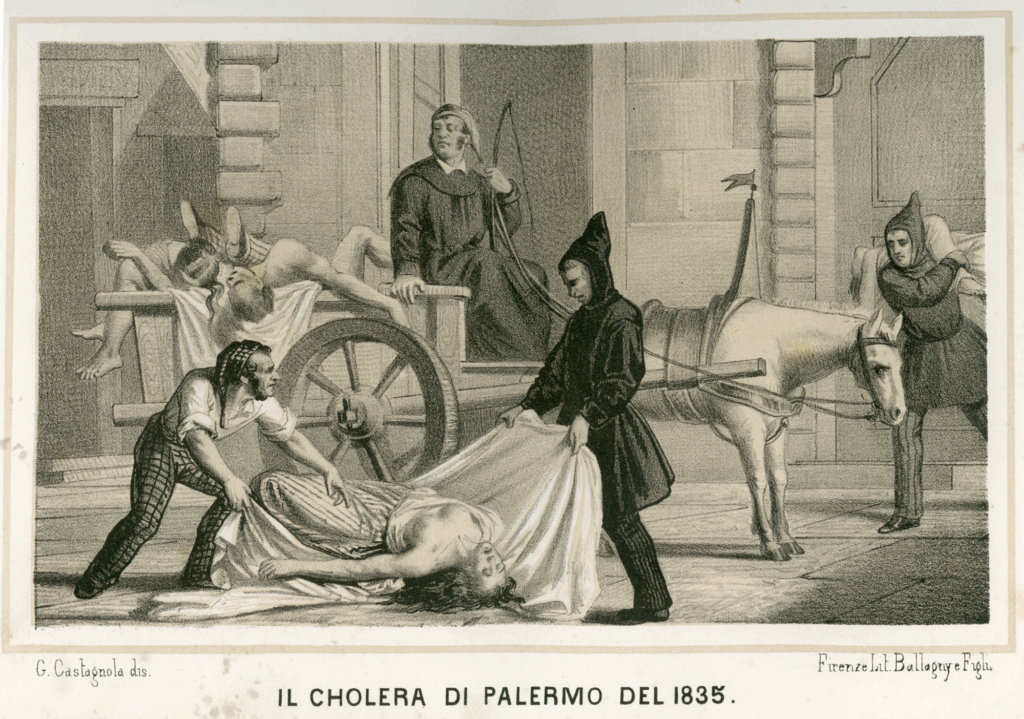
Physicians of the time had no effective answer for the disease. Without modern sanitation standards, they could not disrupt the spread. Without antibiotics, and with a limited understanding of how else to treat it, “quack” cures were common. One was the use of “cholera belts,” or flannel belts wrapped around the abdomen in an attempt to stave off or treat the disease. In other cases, the supposed cures included ingesting mercury, bloodletting, and consuming hard liquor or opiates. These efforts ranged from mildly effective at best to actively harmful or even fatal at worst.
Though misunderstanding and misinformation abounded in this era, doctors began to notice clear patterns. Urban areas experienced more frequent, widespread, and deadlier outbreaks than rural towns.
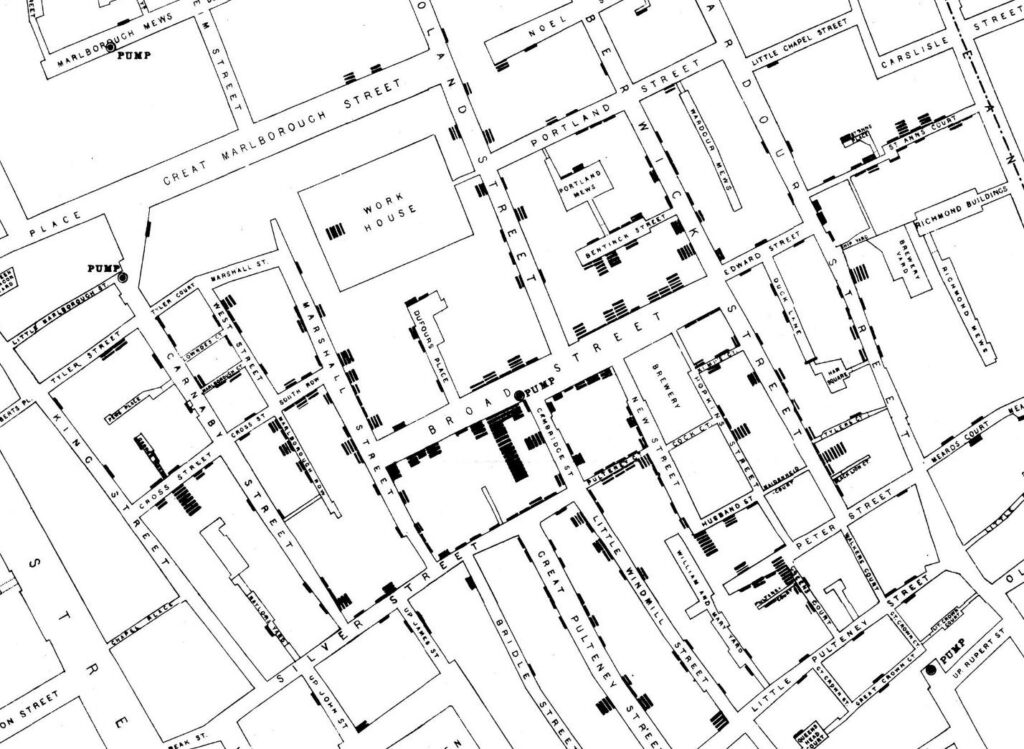
In 1854, London physician John Snow would make one of the most impactful discoveries in the history of sanitation. Eschewing the commonly held miasma theory of the time, Snow mapped occurrences of cholera in the Broad Street ward of London. He noted that cases seemed to radiate from a fixed point: the water pump on Broad Street. By the time he made this discovery, the outbreak had begun to wind down. Nonetheless, upon removal of the water pump handle, thus preventing locals from using the pump, the outbreak’s spread and severity declined rapidly.
For millennia, disease was a mysterious phantom, somehow related to water, air, essence, and form. Doctor Snow’s discovery helped dispel such mythological notions. Disease was material, and it spread through city utilities the way poison circulates through blood.
Snow’s revelations would help inform a series of important infrastructure developments over the next century. The advent of antibiotics, discovered and isolated in the 1920s and made commonplace by the ‘30s, radically altered the course of public health. Previous death sentence diseases became easily treatable. At the same time, a series of technological advancements in water sanitation turned drinking water from a major disease vector to a safe and consistent product.
Advancements in medicine and sanitation since the turn of the 20th century have saved billions of human lives. From the dawn of humanity to the early 20th century, infectious disease was the number one cause of death, only surpassed by heart disease in western countries by around 1920. Yet new threats emerge constantly, and old threats linger.
Hundreds of thousands of people die each year from influenza. Hundreds of thousands more from malaria. Cholera remains a threat in developing and war-torn regions, killing tens of thousands each year. The COVID-19 pandemic resulted in anywhere from 15 to 30 million excess deaths.
Emerging issues such as antibiotic resistance and lagging vaccination rates pose threats to public health. Treating people after they fall ill is the last defense against infectious disease. The first is to prevent its spread altogether–a task best suited to water and wastewater infrastructure.
John Snow’s early epidemiological work reflects modern tracing and tracking of disease vectors in wastewater. Health authorities around the world use advanced sensors to track the presence of bacteria and viral fragments in wastewater, helping them map the spread of disease through urban areas. This data can inform targeted, tactical strikes against disease rather than disruptive blanket quarantines and other undesirable actions.
One of the key innovations in reducing the spread of disease was the commissioning and ongoing expansion of sewer and stormwater systems as discussed in our previous newsletter. Like all underground assets, pipes age and lose their efficacy. Leaky or undersized infrastructure can expose residents directly to sewage, spreading diseases like norovirus and hepatitis. Slow or blocked drains and culverts lead to standing water–often contaminated–that serves as breeding grounds for mosquitoes and other disease vectors.
In specific cases, as seen in Flint, Michigan, the very materials used in the water grid can cause a public health emergency. Upon switching to a more corrosive source of drinking water, the community’s aged pipes began to leach lead, resulting in dangerous levels of lead exposure to the town’s 100,000 residents, 9,000 of which were young children.
Water and sewer systems are critical in the prevention of infectious disease and water contamination in cities. Trenchless technology provides an ideal tool to support and maintain these assets. Trenchless methods of inspection, rehabilitation and replacement align with wastewater epidemiology practices. In many cases, minimizing site excavation provides public health benefits by reducing exposure to waste and hazardous materials, for workers and nearby residents alike.
Typically, trenchless construction methods fall into two main categories: rehabilitation or replacement. The chosen approach will depend on the issues faced with the existing infrastructure, site conditions, and project goals;
Trenchless technology is an ideal tool in preventing infectious disease and water contamination in cities. The very theory of trenchless technology–in-place management of underground assets–supports water and sewer systems as a means to both contain and inspect waste. Trenchless methods of inspection align with wastewater epidemiology practices. In many cases, minimizing site excavation provides public health benefits by reducing exposure to waste and hazardous materials, for workers and nearby residents alike.
The latest semi-structural liners offer quick and effective solutions to leaky or damaged pipes of almost any size and function. This can reduce or eliminate I&I and general contamination issues in many cases. CIPP lining can often be performed in a single day, minimizing disruption to local residents and businesses.
For thousands of years, societies battled disease with partial understanding and improvised solutions, relying on observation and intuition to keep their communities safe. Only in the past two centuries did we uncover the true mechanisms of contagion and build the water, wastewater, and public-health systems that now function as our collective immune system. These systems—born from the insights of pioneers like John Snow and strengthened through modern science, sanitation, and medicine—have saved billions of lives and reshaped human longevity. Yet this progress is not permanent. Aging infrastructure, emerging pathogens, and global health disparities continue to expose points of failure in the very systems designed to protect us.
The lesson is clear: disease prevention begins long before a patient enters a clinic. It starts with clean water, reliable sewer networks, effective monitoring, and timely maintenance. Modern trenchless technologies strengthen this frontline defense by enabling cities to repair, inspect, and renew their underground assets with minimal disruption and maximum precision. As new challenges arise—from antibiotic resistance to climate-driven disease vectors—our best strategy remains the same one that has protected humanity for generations: invest in resilient infrastructure, maintain it intelligently, and keep the lifelines beneath our feet working as the first and most powerful safeguard of public health.
An alternate tendering process where the contract is awarded to one entity which comprises both engineering and contracting.
Because PW Trenchless Construction offers such innovative solutions for underground utilities, it is often beneficial for the owner to request solutions based on a performance specification. This allows PW Trenchess to offer unique solutions while working with equally innovative engineering companies. Learn more about design - build here!
More InfoNew installation methodologies include HDD & traditional open cut Learn more about new installation here!
More InfoIn this day & age of pipe systems reaching the end of their projected lifespan, pipe replacement and pipe rehabilitation have become major fields of engineering.
PW Trenchless Construction provides viable options such as pipe bursting, loose fit lining and internal pipe re-construction whether partial & fully circumferential. Learn more about pipe replacement & rehabilitation here!
More InfoThe aging culverts under roads and highways in many case have reached the end of their engineered life-span. We consider the rehabilitation or replacement of these culverts to be vital to our built environment.
PW Trenchless has been a pioneer in working with MOTH, railway companies and municipalities in developing rehabilitation methodologies for the hundreds of thousands of culverts that currently exist in BC. We have offered solutions in both procurement and construction from design-build to sliplining, invert rehabilitation and full circumferential relining. Learn more about culvert rehabilitation here!
More InfoOften pipe failure can be concentrated to one section, for various reason, leaving the rest of the pipe in good condition. The repair of these localized failures are know as external point repairs (EPR's).
EPR's demonstrate PW's ability to work as both a trenchless and civil contractor, completing EPR contracts using our civil contracting skills and assisting other pure trenchless contractors who only have the capacity to work in an existing pipe. Learn more about point repairs here!
More InfoPipe upsizing is the fundamental concept of pipe bursting.
The vast majority of pipes are less than or equal to 200mm in diameter, but with today's densification practices of urban design, there is a major demand to increase current capacity to handle extra flow. Pipe bursting provides the ideal solution to this issue, particularly in an urban setting. Learn more about pipe upsizing here!
More InfoHorizontal Directional Drilling is a low impact Trenchless construction service where pipe is installed in a shallow arc along a bore path which has been created by a drilling rig. Often the terms Horizontal Directional Drilling (HDD) and Directional Boring are used interchangeably, but in our industry we use the word “boring” when we utilize smaller sized drilling rigs with small diameters for short crossings in the hundreds of feet, and we use the word “drilling” when we utilize larger rigs with large diameters for long crossings in the thousands of feet. Learn more about horizontal directional drilling here!
More InfoPrimus Line® is a flexible sliplining solution for the trenchless rehabilitation of pressure pipes. The system consists of a flexible Kevlar® reinforced liner and specially developed end fittings. Primus Line® is not bonded to the host pipe and is self-supporting. An annulus remains between Primus Line® and the host pipe.
Developed by experienced engineers, the system is suitable for different media as well as various application needs and has already proven itself in numerous projects.Learn more about primus lining here!
More Info





























When you join PWT, you become part of a community of people who are engaged in the most innovative practices in the Trenchless Industry. We have been instrumental in setting up a scientific method for cities to gain carbon offsets/credits from their use of trenchless construction. This system has been reviewed by the BC Government and has been approved as of December 2018. We expect to see it in common use shortly.
Subscribe to our newsletter for cutting-edge industry updates, expert knowledge, and exclusive content.